
The relentless rally in small- and mid-cap stocks continues as large-caps show signs of fatigue. In July, the Nifty Smallcap 100 rose 8.1 per cent, extending its year-to-date (YTD) gains to 48.5 per cent, while the Nifty Midcap 100 added 3.1 per cent, taking its YTD rise to 33.5 per cent. On the other hand, the Nifty50 remained unchanged for the month, with YTD gains of 12.7 per cent.

The S&P BSE Auto Index has been one of the biggest outperformers among sectoral indices over the past year with returns of 26 per cent. By comparison, the benchmarks - the National Stock Exchange Nifty50 and the S&P BSE Sensex - managed about 6-8 per cent during this period. Improving demand, falling raw material costs, and rising product realisations, led by the premiumisation of portfolios, have led to a revision of growth estimates and upgrades by domestic brokerages.

Domestic equity investors' wealth eroded by more than Rs 4.43 lakh crore on Monday as fears of a financial contagion triggered by one of the biggest bank failures in the US roiled market sentiments. After a strong opening, Indian stocks went into a tailspin with the benchmark 30-share BSE Sensex tumbling nearly 900 points to close at 58,237.85 points -- sliding for the third straight trading session. The NSE Nifty too declined 258.60 points to end at 17,154.30 points.

A widening probe by US authorities involving top drug companies following complaints of price fixing of generics was a point of worry for the participants, said analysts.

Mutual funds (MFs) are lining up distinguished new fund offerings (NFOs) for the next financial year to win over investors after a lukewarm response to product launches in the 2022-23 financial year (FY23). NFOs drew a lukewarm response in FY23 as launches were mostly in the passive debt space, which has a comparatively lower popularity among retail investors. The limited launches in equity space also failed to rake in huge sums due to subdued investor sentiments in a volatile market.

'We suggest investors with suitable risk appetite to consider allocating 40-50 per cent in large-caps, 25-30 per cent of funds in quality mid and small-caps and the rest in debt and high yield products.'

'If you are invested in mid-cap and small-cap stocks, even if you are making losses right now, it is better to sell them now and sit on cash.'

Nikunj Saraf, Vice President Choice Wealth, will answers your queries.

Adani Enterprises became the fourth listed company of Gautam Adani Group to cross Rs 4 trillion market capitalisation (market cap), as the stock hit a new high on the BSE in Tuesday's intra-day trade. At 01:24 pm; with Rs 4.04 trillion market cap, Adani Enterprises stood at number 15th position in overall market cap ranking on the BSE, data shows. Adani Transmission is at top of the group companies list, with market cap of Rs 4.48 trillion, followed by Adani Total Gas (Rs 3.96 trillion), and Adani Green Energy (Rs 3.72 trillion).

Benchmark indices continued their downtrend for the fifth session on the trot on Thursday, with the Sensex tumbling nearly 817 points in early trade, tracking weak global trends and selling in index majors Reliance Industries and HDFC Bank. Unabated selling by foreign institutional investors also weighed on the sentiment. The 30-share BSE Sensex was trading 816.78 points lower at 53,271.61. The NSE Nifty declined 234.05 points to 15,933.05.

'Earnings will be the catalyst for markets to march higher from here on out.'

The Sensex soared 402 points higher to end at 25,720 and the Nifty surged 130 points to close at 7,819.

Technical analyst S L Joshi tracks the Indian markets using the Elliott Wave Theory

Two firms belonging to the Adani group - India's most valued conglomerate - are part of the Nifty 50 index. The group, however, has no representation in the Sensex. And it could stay this way if a proposed index qualification rule change gets approved. Recently, Asia Index, a joint venture between S&P Dow Jones Indices and BSE responsible for index composition, floated a consultation paper where it proposed that a stock must have a derivative contract to be eligible for inclusion in the flagship 30-share Sensex index.

Top 5 losers include Infosys, TCS, ITC, M&M and HUL.

'One can start accumulating economy driven stocks in the next few months with a two-three year view.'

Benchmark BSE Sensex rose by 160 points on Thursday in choppy trade following gains in select banking and auto counters amid mixed global cues. The 30-share index gained 160 points to settle at 62,570.68 as 13 of its components advanced while 17 declined. The barometer opened lower but later gained momentum to touch a high of 62,633.56 in the day's trade.

The stock of Divis Laboratories is up 10 per cent over the last couple of trading sessions on expectations that the worst is behind and the company could see a sequential growth in the March quarter of the 2022-23 financial year (Q4FY23). The stock witnessed the highest downgrades among Nifty50 index stocks with earnings cuts over a third after the Q3FY23 results. The company had posted a 32 per cent drop in revenues over the year ago quarter in Q3FY23 and 8 per cent sequentially, which was sharply lower than Street expectations.

Omkeshwar Singh, head, Rank MF, a mutual fund investment platform, answers your queries.

There is little sense in trying to find stocks that will not be vulnerable in a situation where 87% of the market is trending down and India is getting set for a crucial election, says Devangshu Datta.

You can build your own retirement savings portfolio by investing in equity, hybrid and/or debt funds. Alternatively, you can also invest in retirement funds which provide asset allocation solutions for different investment needs and risk appetites, says Dwaipayan Bose
Equity indices fell on Thursday, mirroring weak global market trends following the US Federal Reserve's interest rate hike and hawkish stance. The 30-share BSE Sensex declined 337.06 points or 0.57 per cent to settle at 59,119.72. During the day, it tanked 624 points or 1.04 per cent to 58,832.78. The NSE Nifty went lower by 88.55 points or 0.50 per cent to end at 17,629.80.


Bajaj Finance was the top gainer in the Sensex pack, rising around 3 per cent, followed by Infosys, Titan, Reliance Industries and HCL Tech. NSE Nifty rose 27 points to 17,248.40.

Tata Steel was the top gainer in the Sensex pack, climbing 2.11 per cent, followed by Infosys, HDFC Bank, HDFC, Kotak Bank, M&M and PowerGrid. NSE Nifty jumped 142.05 points to end at 17,605.85.

Gross inflows into active equity mutual fund (MF) schemes dipped 34 per cent month-on-month (MoM) -- to Rs 25,400 crore -- in April as investors applied brakes on lump sum investments amid a sharp upwards movement in the market. Gross inflows for March stood at Rs 38,641 crore. The sharp decline pulled the net inflows to a five-month low of Rs 6,480 crore, shows data released by the Association of Mutual Funds in India (Amfi).

Sensex, Nifty post biggest weekly fall this year on inflation data.

The Sensex came under fag-end selling pressure to close in the red for the sixth straight session on Friday as risk-off sentiment prevailed amid unabated selling by foreign institutional investors and concerns over inflation. The 30-share BSE benchmark pared all intra-day gains and declined 136.69 points or 0.26 per cent to end at 52,793.62. During the day, it had rallied 855.4 points or 1.61 per cent to 53,785.71. On similar lines, the broader NSE Nifty dipped 25.85 points or 0.16 per cent to settle at 15,782.15.
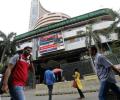
Sensex rises, Nifty holds 8,900; FMCG, Pharma shares lead.

RBI's fifth bi-monthly monetary policy meet due tomorrow also kept the investors on their toes.

After a sharp correction over the last few months, analysts seem to be turning cautiously optimistic on the information technology (IT) sector and suggest there could be trading opportunities in select counters despite revenue and growth concerns that still plague the sector. "IT stocks valuations have corrected 17 per cent-49 per cent and stock prices have corrected 9 - 42 per cent since mid-December 2021. Nifty IT index valuation has corrected by 27 per cent and price by 21 per cent. "About two quarters ago, we made a case that valuation drivers have peaked.

'Such big falls are quite frequent these days, so do not try to time this market.' 'Use big dips to accumulate quality stocks.'

The rupee depreciated 31 paise to an all-time low of 80.15 against the US dollar in early trade on Monday tracking the strength of the American currency and firm crude oil prices. At the interbank foreign exchange, the rupee opened at 80.10 against the dollar, then lost ground to quote at 80.15, registering a fall of 31 paise from the last close. On Friday, the rupee closed at 79.84 against the dollar.

IT majors weakened ahead of the September US jobs data and telecom stocks ended lower

BSE benchmark Sensex nursed losses on Friday as investors pocketed gains after a five-session winning streak amid a bearish trend overseas. A depreciating rupee and foreign fund outflows further soured risk sentiment, traders said. The 30-share gauge, which had started the trade on a firm note, soon gave up all the gains and finally ended 651.85 points or 1.08 per cent lower at 59,646.15. The broader NSE Nifty snapped its eight-day rally to close at 17,758.45, down 198.05 points or 1.10 per cent.

Sensex ends 134.91 pts down at 28,709.87; Nifty falls 44.70 pts at 8,712.05.

Despite markets turning volatile, share sale activity at India Inc has surged to its highest level in five months. So far in March, promoters, strategic investors and other large shareholders have been able to offload shares worth more than Rs 33,000 crore-the most since November-defying uncertain market conditions. Both the Sensex and the Nifty are on course to post their fourth straight monthly loss amid headwinds, such as interest rate tightening by the US Federal Reserve and the global banking crisis.
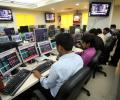
On the BSE, 1,493 shares declined and 1,236 shares rose. A total of 177 shares were unchanged

In the broader market, BSE midcap and BSE smallcap indices underperformed the larger counterparts and ended flat with a negative bias.

The Nifty IT has been one of the worst-performing indices on the bourses this calendar year. Rising concerns of a potential global recession, which investors fear can dampen demand for export-facing domestic information technology (IT) giants, have sent the index down over 30 per cent on a year-to-date basis. By comparison, the Nifty50 Index has shed 2.8 per cent during the period, reveals data by ACE Equity.
